Did you know a sharp knife is 20% more efficient than a dull one? This fact shows how key knife skills are in the kitchen. Home cooks can improve their cooking with just a few important techniques. Learning these skills makes meal prep faster and makes dishes look better.
As a professional cook, I’ve learned that the right grip and cutting methods change your kitchen time. In this guide, I’ll cover ten essential knife skills. These skills are vital for kitchen mastery and make cooking fun.
Key Takeaways
- Proper knife grip increases control and precision.
- The claw technique is essential for protecting fingers while cutting.
- Chopping involves quick, uniform cuts for efficient prep.
- Slicing requires a smooth motion for optimal results.
- Dicing produces even cubes for consistent cooking.
- Julienne and chiffonade techniques enhance ingredient presentation.
- Regular maintenance keeps knives performing at their best.
The Importance of Mastering Knife Skills
Learning to use knives well is key to better home cooking. The right ways to cut food make meal prep faster and safer. This is important for kitchen safety.
Efficiency in Meal Prep
Knowing how a knife works is the first step to quick meal prep. Holding the knife right, with knuckles forward, makes chopping easier. Keeping the blade on the cutting board helps use the knife’s full motion.
With practice, chopping gets faster. This makes cooking smoother and quicker.
Improved Safety
Keeping safe with knives is very important. Sharp knives are safer because they cut better and need less force. Keeping knives sharp helps avoid accidents from dull blades.
Using a non-slip cutting board and the claw technique protect my hands. Learning different cutting methods makes cooking safer and better.
Essential Knife Skills Every Home Cook Should Learn
Learning essential knife skills makes cooking safer and more efficient. It’s key for any home cook. Mastering a proper grip and basic chopping, dicing, and mincing techniques helps me cook with ease and confidence.
Proper Knife Grip
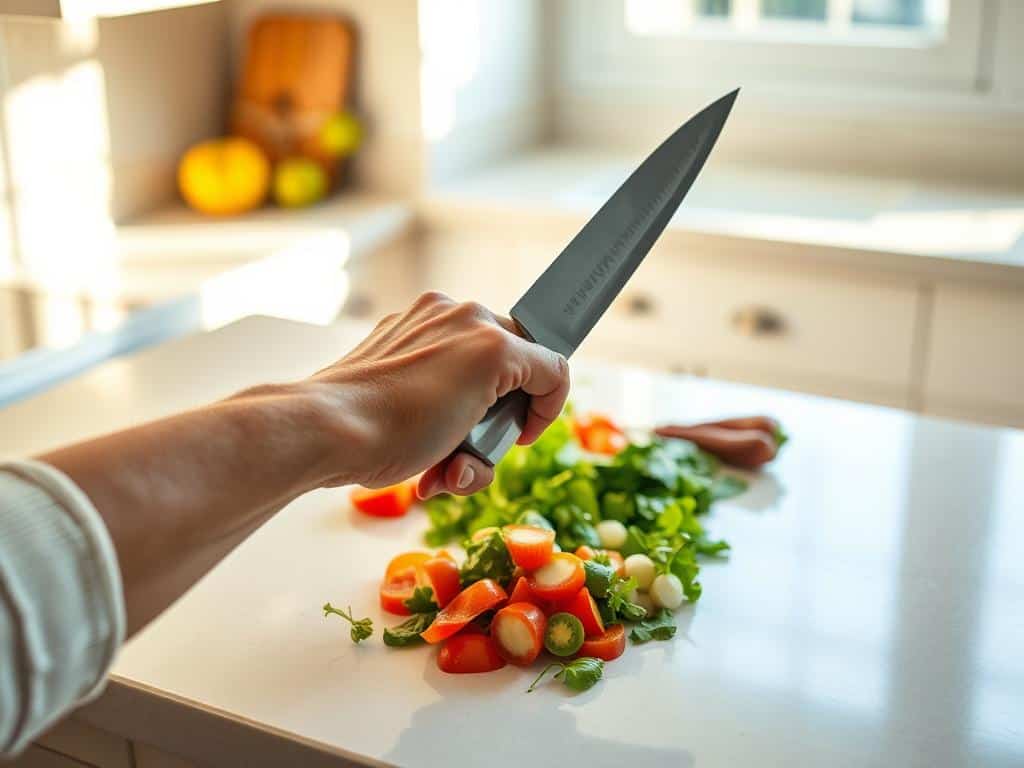
The right knife grip is the base of good cutting. I often use the pinch grip, pinching the blade above the bolster and wrapping my other fingers around the handle. This grip helps me control the knife better. I also try the handshake grip for strength and stability in different cutting tasks.
The Claw Technique
The claw technique protects my fingers and ensures even cuts. I tuck my fingers inward and use them to guide the knife. This method is great for basic chopping, making cuts quick and precise.
Chopping and Slicing
For chopping, I rock the knife while keeping the tip on the board. This works well for herbs and quick tasks. When slicing, I use a gentle sawing motion for soft veggies and firm strokes for harder ones. Keeping slices even helps with even cooking.
Dicing and Mincing
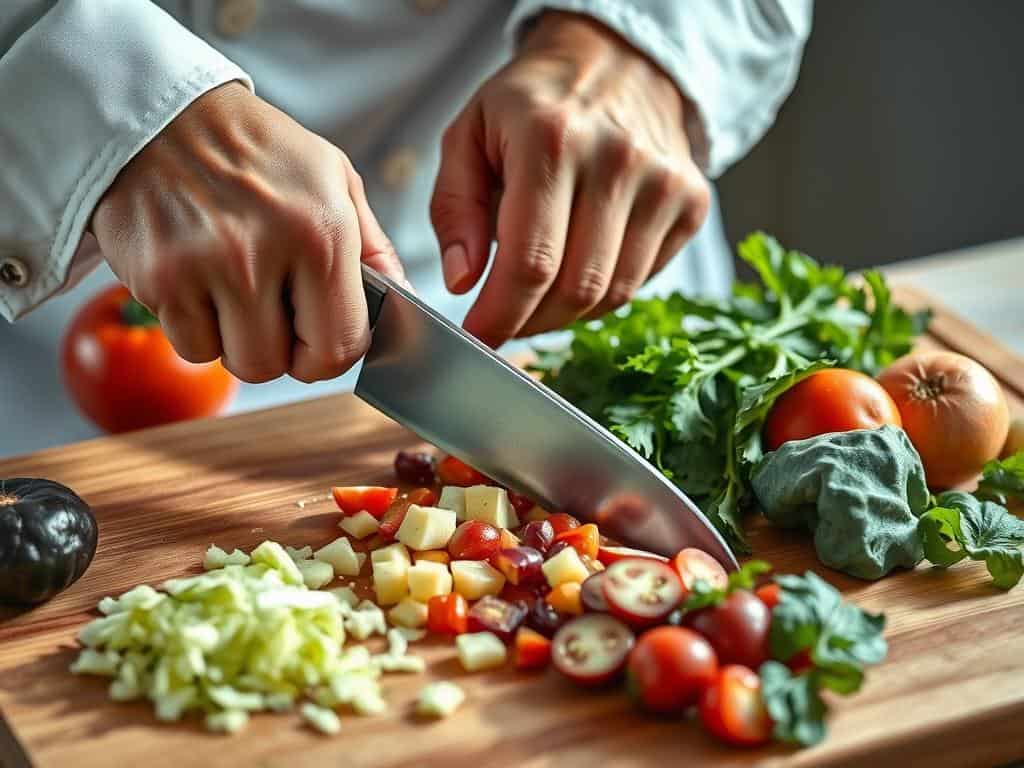
Dicing starts with a flat surface, then slicing into equal widths, and stacking for more cuts. I choose small, medium, or large dice based on the recipe. For mincing, I finely chop ingredients like garlic and herbs to boost flavor. These skills are vital for improving your cooking.
Advanced Knife Skills for the Aspiring Chef
After mastering basic knife techniques, I dive into advanced skills. These skills boost my cooking quality and kitchen efficiency.
Julienne and Chiffonade Techniques
Learning to julienne lets me cut veggies into thin strips. This is great for salads and stir-fries. It adds texture and looks.
Chiffonade technique helps me slice herbs and greens into fine ribbons. These are perfect for garnishing. Both skills show my focus on presentation and culinary skill, making meals both tasty and beautiful.
Deboning and Filleting
For those who love cooking with meats and fish, deboning and filleting are key. These skills help me get the most meat while keeping cuts intact. With practice, I improve my dishes and cooking speed.
Getting good at these skills has led me to more professional cooking. It’s a big step up.
Conclusion
Learning to master knife skills has changed my cooking game. These skills make cooking faster and safer. They also help me avoid wasting food.
Knowing how to hold and use a knife is key. It lets me cut ingredients evenly. This makes my dishes taste better and look great.
Practicing knife skills has made a big difference. Now, my ingredients taste better and my dishes look amazing. It’s all about using simple ingredients to make great food.
I’ve spent over 12,480 hours improving my knife skills. It’s all about practice. Using sharp knives and focusing on basics is important.
It’s also about being patient and not showing off too soon. By practicing with simple veggies, I’ve found joy in cooking. And I make sure my kitchen is safe.